

From left to right: Dr. Kyle D. Warren, Dr. Angela Starkweather, and Dr. Leorey Saligan. All photos in this article courtesy of the School of Nursing.
As a teenager, Dean Angela Starkweather did not think she would be going into nursing. Although her mother was a nurse in rural Yakima, Washington, she initially resisted following in her footsteps. She entered college convinced she would pursue the arts, but soon after, she discovered that nursing offered the combination of creativity, science, critical thinking, and human connection she was looking for. An undergraduate experience in Taiwan broadened her perspective on nursing and healthcare, as she witnessed firsthand how care differs across countries and communities. Her career subsequently took her to several U.S. states, including Illinois, Connecticut, Florida, Virginia, and New Jersey, where she also experienced how health care systems vary across the United States. Seeing the disparities across health care practices and how much legislation and policy can shape access to and quality of care in the United States deepened her interest in the larger systems that influence health. Her global experiences also gave her a broader perspective, showing her how other countries often place greater emphasis on prevention and helping people manage their health outside the hospital, while the U.S. system tends to focus more heavily on acute care. A particularly personal experience with a coworker and her newborn brought those disparities into sharp focus, ultimately leading her to her current role as dean, Chief Wellness Officer, and professor where she is focused on preparing the next generation of nurses to address increasingly complex health challenges.

Dean Angela Starkweather
Today, her experiences shape and reflect the School of Nursing’s commitment to improving health beyond the hospital. Students gain experience in community settings and are prepared to address the Social Determinants of Health, navigate complex health care systems, and help patients access the resources they need.
Its partnerships extend beyond hospitals, including:
- The #1 midwifery program in the northeast that addresses New Jersey’s high maternal mortality rate.
- The Francois-Xavier Bagnourd Center provides primary care, HIV services, education, and statewide case management for children in foster care.
- Their new Center for Health Equity and Systems Research (CHESR) brings together faculty and collaborators to advance health equity research.
- Partnerships with behavioral health services to provide clinical placements and prepare nurses to address mental health needs.

2nd degree nursing students and Dr. Carol D’Innocenzio in simulation
On a global scale, the school has programs that address maternal care, sickle cell disease, stroke and cardiovascular disease, oncology, and palliative care in Tanzania, Ghana, and Botswana. A notable international collaboration with the University of Botswana helped develop a master’s program in oncology nursing. Participation in these global programs allows students to see how health care is administered in other countries and how it’s different from the United States. Through research, education, and community partnerships, the school is working to advance health equity while preparing nurses to meet the changing needs of patients and communities.
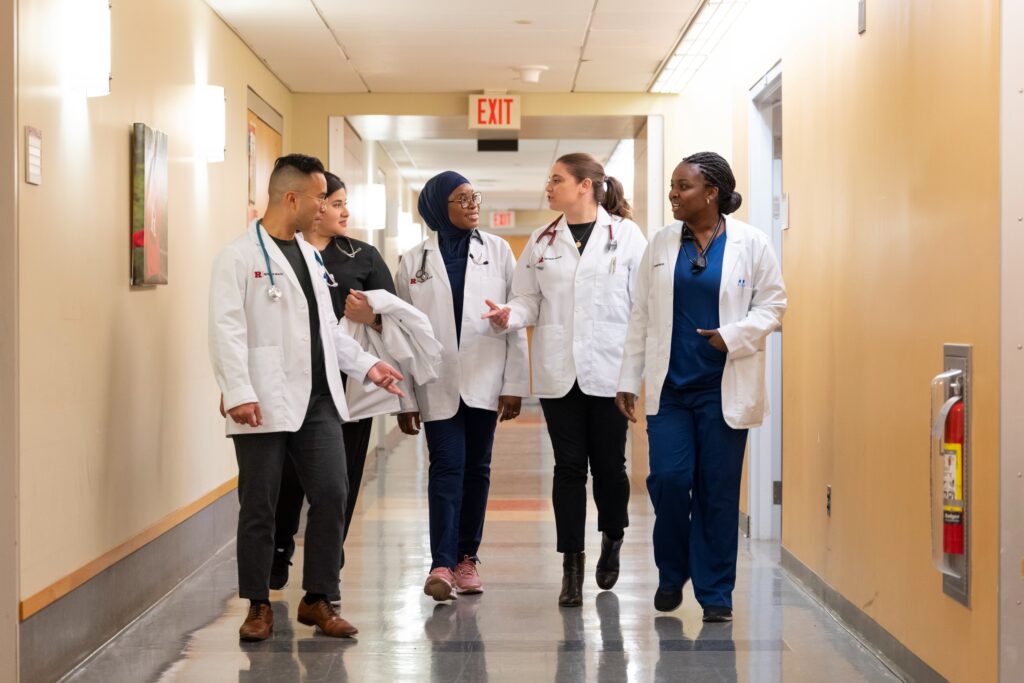 Graduate student nurses in Stanley S. Bergen Building
As the school celebrates its 70th anniversary, its history reflects a period of significant growth and transformation, including institutional mergers and its integration into Rutgers Health. The school’s development also builds on the legacy of Dr. Hildegard E. Peplau, whose pioneering work helped establish psychiatric mental-health nursing as an advanced practice discipline. That legacy continues to shape the school’s approach to mental health education, suicide prevention, and community-based care. The Blackwood campus represents another important milestone, expanding access to nursing education and strengthening the school’s presence in southern New Jersey. At the New Brunswick campus, undergraduate enrollment has also increased in response to the ongoing nursing shortage. The school is particularly important to New Jersey’s workforce because more than 90% of its graduates remain in the state, further expanding the school’s role in preparing nurses to meet the region’s growing healthcare needs.
As the school looks toward the future, Dean Starkweather emphasized the importance of continued growth and technological advancement. These developments will play an important role in the future of nursing education and practice. The school is exploring the use of artificial intelligence, virtual nursing, remote monitoring, and technology-enabled care in the home, including tools that collect biometric and environmental data. These advancements could support patients, particularly older adults who remain at home while still maintaining direct access to nursing care. Alongside its focus on technology, the school is developing a nurse education, innovation, and technology program designed to create additional pathways for nurses to become educators. The initiative could help expand the nursing faculty pipeline and address the ongoing shortage of nursing educators.
Through 70 years of growth and change, the school’s message remains clear: nursing extends far beyond hospital-based care. Nurses are educators, advocates, care coordinators, researchers, community partners, and innovators who help people navigate complex healthcare systems, strengthen the health of their communities, and improve health before serious illness occurs.
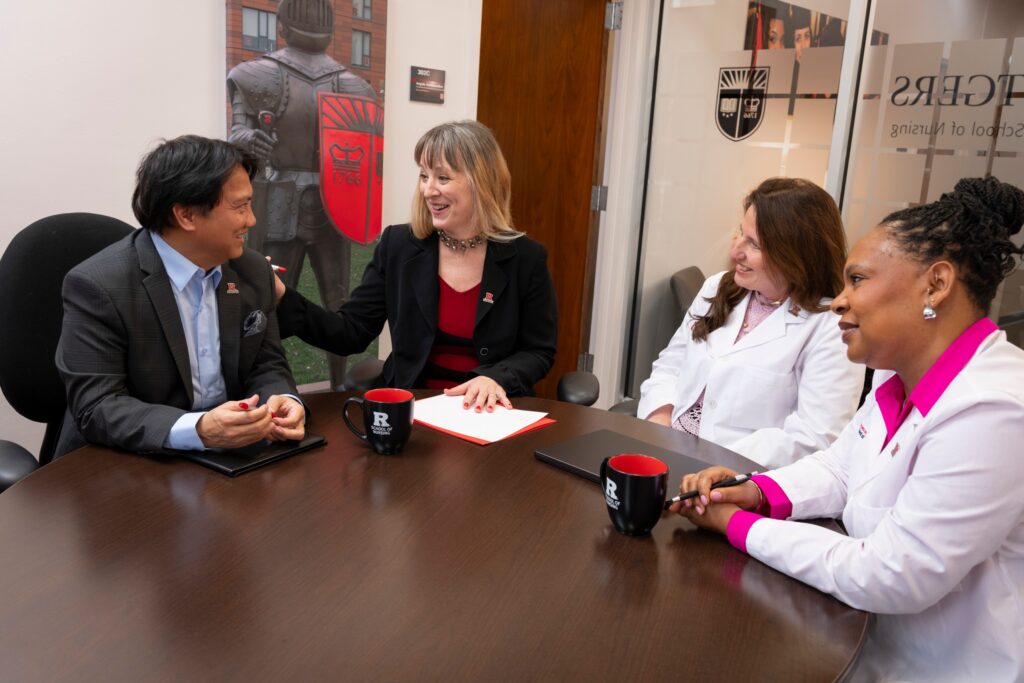
From left to right: Dr. Leorey Saligan, Dean Angela Starkweather, Dr. Carol D’Innocenzio, Dr. Joset Brown
Rutgers School of Nursing ranks No. 27 among 671 undergraduate nursing programs nationwide in the 2027 U.S. News & World Report Best Colleges rankings, placing it among the top 4% in the country. This historic achievement represents the school’s highest-ever ranking since U.S. News launched its undergraduate nursing program rankings in 2022. The ranking adds to Rutgers School of Nursing’s strong national standing across degree levels. In the 2026 U.S. News & World Report Best Graduate Schools rankings, the school’s Doctor of Nursing Practice program ranked No. 12 nationally and its Master of Science in Nursing program ranked No. 16. Both programs also rank No. 1 in New Jersey.